

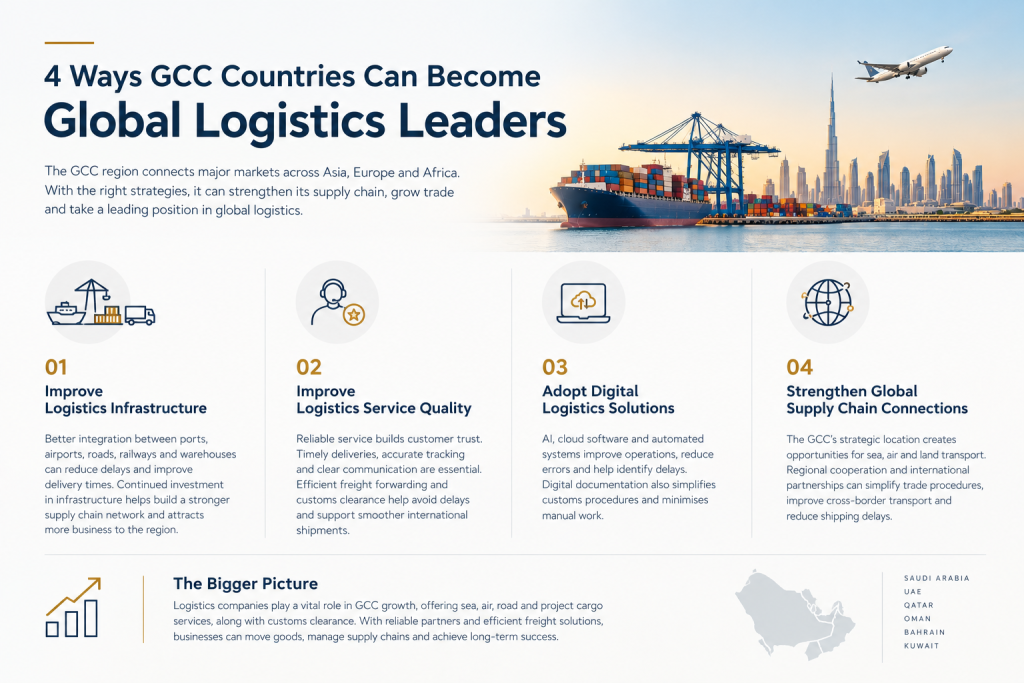
The GCC logistics industry has great potential to become a global leader. Countries such as Saudi Arabia, the UAE, Qatar, Oman, Bahrain, and Kuwait connect major markets across Asia, Europe, and Africa.
However, the region still faces some logistics challenges. These include limited infrastructure integration, service quality gaps, and outdated processes. By addressing these issues, GCC countries can improve transportation, support international trade, and strengthen their global position.
Here are four ways the GCC logistics industry can achieve long-term growth.
1. Improve Logistics Infrastructure
Modern infrastructure plays an important role in the GCC logistics industry. Ports, airports, roads, railways, and warehouses help businesses move goods between countries.
However, these facilities must work together. Better connections between ports, airports, and distribution centres can reduce delays and improve delivery times.
For example, Saudi Arabia and the UAE continue to develop their logistics networks. These investments can support international trade and attract more businesses to the region.
As a result, better infrastructure can help GCC countries build a stronger supply chain network.
2. Improve Logistics Service Quality
Reliable service helps logistics companies build customer trust. Businesses need timely deliveries, accurate shipment tracking, and clear communication.
Therefore, logistics providers must focus on customer satisfaction. They can improve their services through better planning, trained staff, and modern tracking systems.
In addition, efficient freight forwarding and customs clearance can help businesses avoid unnecessary delays. These services also support smoother international shipments.
By improving service quality, GCC logistics companies can attract new customers and build long-term business relationships.
3. Adopt Digital Logistics Solutions
Technology is changing the way logistics companies operate. Digital tools help businesses manage shipments, track goods, and control inventory.
For instance, artificial intelligence, cloud software, and automated warehouse systems can improve daily operations. These tools also help companies identify delays and make faster decisions.
Moreover, digital documentation can simplify customs procedures. It can also reduce paperwork and minimise manual errors.
As global trade grows, digital transformation will become increasingly important. GCC logistics companies can use these solutions to improve efficiency and deliver better customer experiences.
4. Strengthen Global Supply Chain Connections
The GCC region has a strategic location between major international markets. This advantage creates opportunities for freight forwarding, sea freight, air freight, and land transportation.
However, stronger regional cooperation is essential. Governments and logistics companies can work together to improve cross-border transportation and simplify trade procedures.
Furthermore, international partnerships can help businesses reach new markets. Better coordination between transport providers, customs authorities, and distribution centres can also reduce shipping delays.
Consequently, stronger supply chain connections can help the GCC become a preferred destination for international logistics operations.
How Logistics Companies Support GCC Growth
Logistics companies play a vital role in regional trade. They help businesses transport products, manage shipments, and maintain efficient supply chains.
Services such as sea freight, air freight, road transportation, project cargo, and customs clearance support businesses across different industries.
For this reason, companies need reliable logistics partners. An experienced provider can help businesses plan shipments, manage transportation, and improve delivery performance.
MFS Logistics supports businesses with logistics solutions designed to meet their transportation and supply chain needs. By focusing on reliable service and efficient cargo movement, logistics providers can contribute to the continued growth of the GCC logistics industry.
Conclusion
The GCC logistics industry has strong potential for future growth. Modern infrastructure, better service quality, digital technology, and stronger international connections can help the region compete in global markets.
By focusing on these four areas, GCC countries can improve supply chain efficiency and create new opportunities for international trade.
At the same time, businesses can benefit from choosing reliable logistics partners. Efficient transportation and professional freight services can help companies manage shipments and support long-term growth.